
I’ve never been a big one for apps or tech. I had an old school phone for as long as I could, only crumbling when I couldn’t access the bus timetable without a QR code.
But now tech is deeply interwoven with our lives, including running. I couldn’t imagine leaving the house without my smart watch and the first thing I do following a hard run is check my stats.
I rely enormously on my phone for coaching – everything from videoing runners to assess form to measuring power production. And I track runners’ progress via Strava and use Runhive’s training tools to analyse potential and set training.
Modern coaching now relies on these tools to assess, monitor and review – the core components of the coaching cycle.
Yet as a coach, everything I do is potentially threatened by the rise of AI and running coach apps; all providing bespoke plans and training programmes, based on your personalised data, for a fraction of the cost and available immediately.
The criticism for many years was that a cookie cutter plan from the internet was just that – cut from the same cloth and applied to the masses. Now with your watch reading your data, using predictive algorithms, runners have access to something far more personal. Recent changes to Strava even offer an entry level in, providing assessments (sometimes hilariously) of your progress to date. Does it mean that in the face of the tech revolution, I’m out of a job?
It was starting to look that way. So imagine my surprise when I was doing my regular athlete review (because I stalk you even when you don’t know I am), I stumbled across this on Strava –
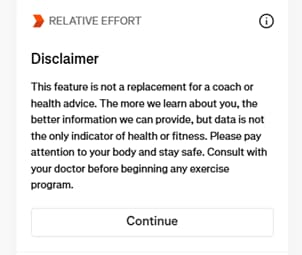
Which got me thinking. If Strava isn’t replacing a coach, why do human coaches offer which makes them still needed?
Human coach over apps
- Companionship. A coach will cheerlead you and absolutely celebrate your successes. But it’s more than that. Running can be quite a lonely, but all-consuming, endeavour. Your long suffering spouse cares for your happiness but cannot see the causal link between said happiness and Vo2 max splits. A coach is someone you share your running journey with, who is as invested as you are. Who wants to see the one second pace improvement up that hill. Who knows how many days it is to your next goal race. Who gets that you’re dreading a tough intervals session on Wednesday. (etc.)
- Accountability. An app can give you a notification, but there’s nothing like a quick message from coach asking how you’re getting on to make you lace up your shoes. Nothing like knowing someone will be counting your reps when you’re thinking of bailing on a session. Nothing like someone giving you a poke for your tough intervals session on Wednesday. An app can be ignored, I can’t.
- Humanity. Ahh the oft-stated “personal touch”. Sure, coaches are more human than computers (doh!) but the personal touch is not actually what clients want. What they want are outcomes, which are inherently linked to their circumstances. What human coaches provide is not only empathy or intuition in the moment, but also the ability to apply external factors that even you hadn’t considered.
- Reading between the lines. Some of the greatest intel I pick up from my athletes is either unspoken or unconsidered by them. The look when I adjust paces, the body language during a tempo run, the excitement (or lack of) when I send through the next block. Anything that’s odd for you immediately prompts me to ask: How was your sleep last night? Shall we dial it back? Are you due on your period soon? What are you feeling – right now?
These aren’t mutually exclusive but are the reasons for having a coach – human or technological – in the first place.
Human v app in practice
Say your easy runs are becoming more difficult – you’re dropping pace or your heart rate is too high. Both the app and the coach would agree that something needs to change. While an app might modify your data to change your paces, a coach will ask why.
Through that question, the coach might discover that work is particularly busy and you’re up until 2 am and getting up at 6 am. The coach might suggest a couple of rest days, shifting the monthly programme around the difficult period. The coach will reassure you that progress is possible, it’s just adapting around your current circumstances. And it is that analysis where coaching comes into its own.

Running coach apps over human
A pocket AI-powered coach can work where you have a particular short-term goal. Where you’ve been training yourself for a long time, and you’re interested in trying out a new approach. As an initial investment, running coach apps are also cheaper – although having a bespoke plan from a coach is of course yours, one you can reuse and modify in the future. But if you’re a marathoner looking to improve your 5km time and you need a frame of reference to work in. If you know what days you want to run and how to prioritise. If you know your limits and are happy using the tools as just that, tools, then absolutely try an app. We’re all just an experiment of one after all.
But when you need someone to care when you succeed, help you when you fail, kick you out of the door when you need it or provide a cwtch when you need that. When you need someone to question your own truths and draw on experience to come up with a different solution, then a running coach is going to provide far more return on your investment over the long term than an app. And as runners, we’ve always got our eyes on the next long-term goal.
If you fancy working with a human, then drop me a message – Contact – RunVive